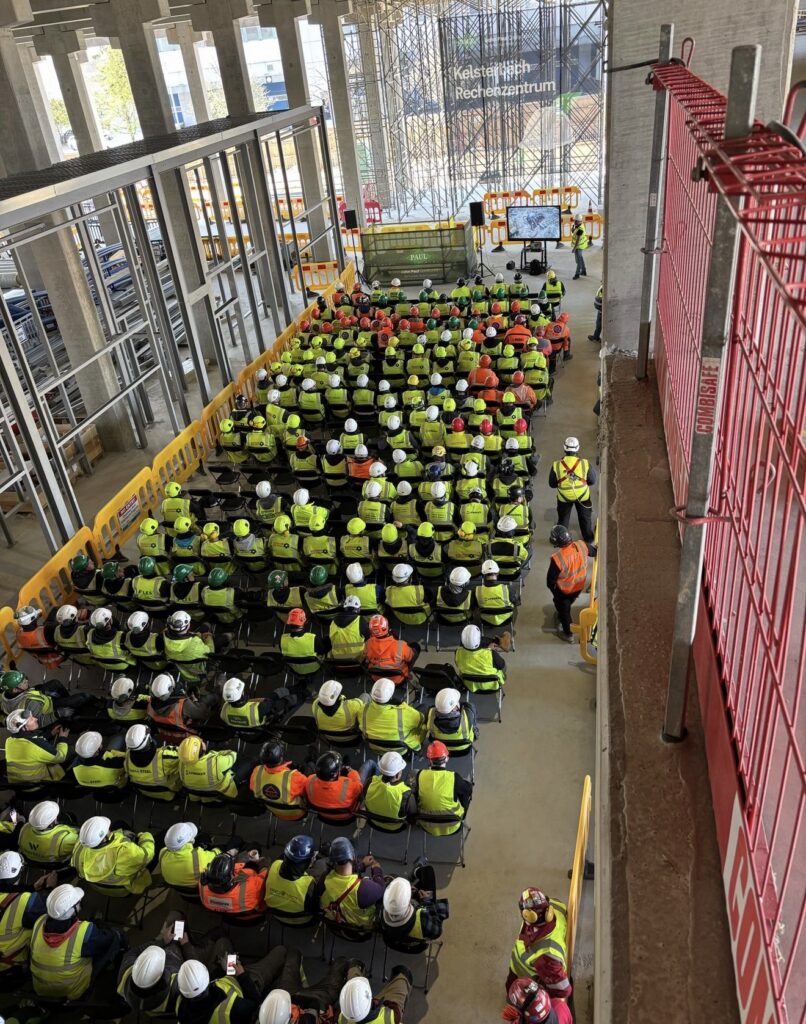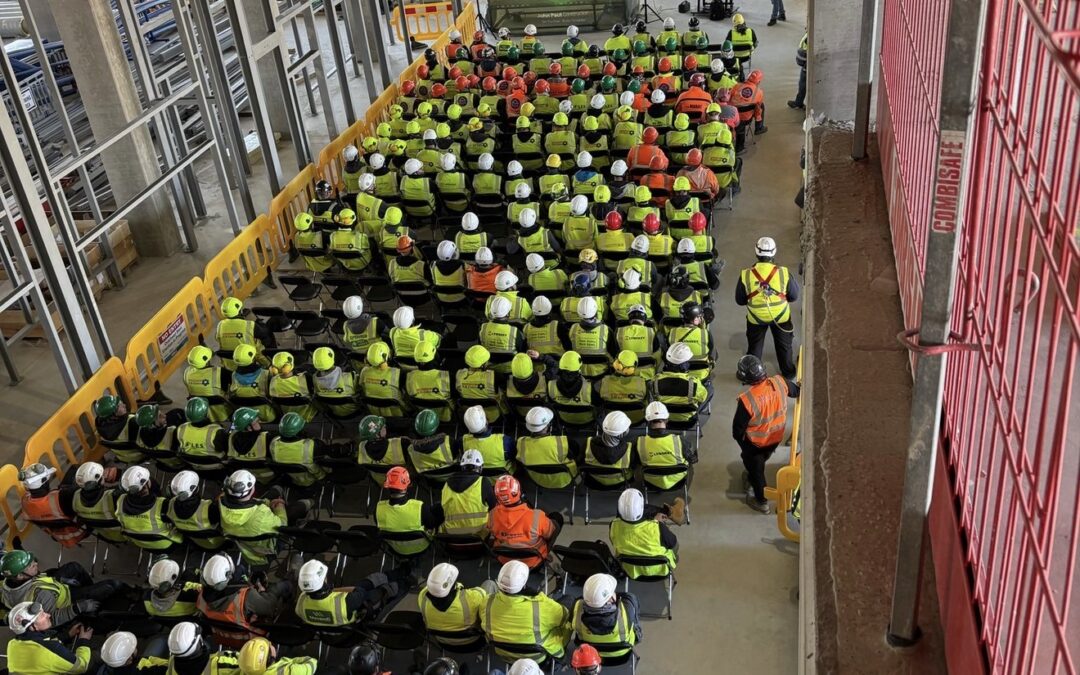
I am Steven Kirby, founder of SKLifeCoachUK. I work as a workplace safety and mental wellbeing speaker across the United Kingdom and Europe. The photograph with this post was taken while I was speaking for John Paul Construction on the Kelsterbach Rechenzentrum project in the Frankfurt area of Germany.
This was not a hotel conference. It was a live construction site. Hundreds of people in high-visibility clothing and hard hats sat in rows between temporary barriers, with scaffolding and unfinished structure around them. That is the setting in which safety messages either land or disappear.
The Frankfurt site
Kelsterbach sits beside Frankfurt Airport and forms part of the wider Frankfurt data-centre market. John Paul Construction is delivering the project as general contractor. A briefing of this size brings together a large, mixed site workforce under programme pressure and significant residual risk. It is also the right place to speak: directly to the people whose daily choices determine whether everyone goes home.
Why I was invited to speak
I do not deliver a lecture on regulations. I share lived experience.
I spent twenty years in construction, progressing from groundworker and plant operator to site supervisor. In 2011, during a hydrostatic pressure test, a pipe failed. One choice put me in the line of fire. I survived. Physical recovery was only the beginning. PTSD, anxiety and depression followed, and the consequences reached my confidence, identity and family life.
That is the foundation of my keynote, One Choice, One Life. It addresses behavioural safety, shortcuts, time pressure, the difference between confidence and competence, the habit of saying “it’ll be alright,” and the connection between mental wellbeing and the decisions people make on site.
Why this conversation belongs on European projects
Safety culture does not stop at a national border. Large European construction and data-centre programmes often involve mixed contractors, mixed languages and mixed expectations about speaking up. Procedures can be written to a high standard and still fail if people do not feel able to stop work, challenge an unsafe condition or admit they are not coping.
A talk on a Frankfurt-area site has a different quality from a conference room. The audience is wearing the same kit I used to wear. They recognise the pressure to keep the programme moving. They know what it feels like when something does not look right and the job still needs to finish.
My aim in that room is straightforward:
• make the consequence of a poor choice personal, not theoretical
• encourage people to stop and reassess risk before an incident occurs
• make it acceptable to speak up and report
• connect safety performance with mental wellbeing, because distraction, fatigue and unspoken pressure affect judgement
What site teams take away
Construction teams rarely need another list of statistics. They need a reason to take the next decision differently. When people understand what a workplace incident can do to a family, a career and a person’s mind, the conversation changes.
I deliver this work for construction, engineering, utilities and infrastructure organisations throughout the UK and Europe: safety stand-downs, project briefings, leadership sessions and conferences. The format can be adapted to the audience and the risks on that project.
If your organisation is looking for a safety speaker in Europe who has done the job, survived a serious workplace accident and now works with the mental aftermath as well as the physical one, I would welcome a conversation.
Book a workplace talk: sklifecoachuk.co.uk/contact-me
Telephone: 01482 249930
Email: steven@sklifecoachuk.co.uk
One choice can change everything. The people sitting in those chairs already know that in theory. My work is to make sure they remember it when the pressure is on.